


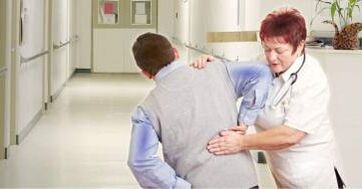
Back and lumbar pain is one of the most common complaints in medicine.They are second in number of claims, second only to respiratory diseases.Many diseases can cause pain in the lower back, but the most common cause is osteoarthritis in the lumbar region.How to treat such a disease, its symptoms and signs will be discussed below.
Not so long ago, medical science believed that osteoarthritis in the lumbosacral region occurs solely due to age-related changes that lead to wear and tear of the vertebrae and intervertebral discs.However, today's symptoms of aging are not unique;Lumbar spondylosis is diagnosed in patients of various ages.Nowadays, the age limit is considered to be over 25 years old.
Causes of lumbar spondylosis
It is impossible to name the exact reason;Almost always it will be a complex effect of various destructive factors, among which the most important can be identified:
- Commitment to a passive lifestylefrom the point of view of motor activity.By their own volition, people who are immobile, for example, spending many hours at the computer, do not receive enough useful load, which is why the "corset" muscles relax and the load on the vertebrae increases.In addition, almost always such pastime is associated with prolonged exposure to incorrect and unnatural positions.
- Problems with hormone levels, leads to metabolic disorders, affects the metabolism of spinal tissue in the lumbar region and contributes to the destruction process.This also includes diseases of an endocrine nature.
- Presence of congenital or acquired abnormalitieswhen the musculoskeletal system undergoes certain changes.This may be reflected in increased load on the spine, for example, in patients with flat feet, bowed legs or a spine.
- Chronic increased loadin the lower back.Here, the risk includes people performing certain types of occupational activities, often involving heavy lifting.This also includes professional athletes, who are often subjected to the highest loads.
- Food intake and daily routine are disrupted.This also includes being constantly exposed to stress.These factors affect metabolism and affect the body's periodic recovery of strength.
Degrees of osteoarthritis of the lumbar spine
The above pathological factors gradually lead to manifestations of the disease.However, it can manifest itself in different ways, being practically asymptomatic at the beginning or causing unpleasant pain in its late development.Let's consider the main stages of development of osteoarthritis:
- Condition in which the nucleus pulposus moves inside the disc.It is characterized by pain due to irritation of the nerve roots of the annulus fibrosus and longitudinal ligament.Localized discomfort in the area of the defective disc.The pain can be acute with shooting or constant dull.
- When the fibrous layer of the intervertebral disc is destroyed, the mobility of the spinal elements in this area increases, and they become unstable relative to each other.To eliminate these pathological manifestations, it is necessary to constantly keep the muscles in this area in tension, which eventually leads to chronic fatigue in the lower back.
- Next, a breakthrough occurs in the annulus, causing the nucleus to escape beyond the boundary of the disc, forming an intervertebral hernia.Such a case will be accompanied by compression of nerve endings, called “nerve root syndrome”.
- The next level of osteonecrosis of the lumbosacral region occurs with severe deformity of the spine in this part.Problems with mobility appear, but strangely enough, the pain syndrome subsides at this stage.However, you shouldn't get excited;This does not mean that the disease is dying out.
- The final degree is characterized by pathological development of bone tissue and general deterioration of health.
Based on the degree of lumbar osteoarthritis, certain treatment methods are used.
Symptoms of osteoarthritis in the lower back
The main symptom is combat syndrome in the lumbar spine.At the same time, pain sensations, their localization and direction of spread may be different.This happens because based on the level of damage to the disc and surrounding tissues, certain nerve receptors will be stimulated.In addition, the presence of a protrusion or the hernia itself, the direction of its protrusion and many other factors also play a role.
The main symptoms of lumbar spondylosis include:
- The appearance of pain in the lower back area, which tends to increase with sudden movements or, conversely, without changing position for a long time.The pain is reduced if you maintain a horizontal position.
- Additionally, there may be weakness in the body area below the abdomen, including the lower limbs, as well as blunted tendon reflexes in the legs.
- High likelihood of lumbar spine curvature.There is a way to classify such curvatures, for example, when emphasizing the right or left side, they talk about scoliosis, scoliosis is a condition of forward bending, and kyphosis is a case where the natural lumbar curve seems to be flattened.
- With severe progression of the disease, there can be compression of the spinal canal, which can cause dysfunction and lead to uncontrolled urination and defecation.
Additional symptoms include:
- The appearance of a feeling of numbness and “coldness” in the skin of the lower back and buttocks.
- Skin is peeling, dry and blue in the same place.
- Poor urination.
- Erection problems.
The presence of these symptoms should alert a person;one should not abandon them, this will only lead to more neglect.In this case, you should definitely consult a doctor for accurate diagnosis and treatment.By the way, the treatment can be done in the hospital or at home, but more about that later.
Diagnosis of disease
When making a diagnosis, it is important to understand how the disease has progressed.The easiest way is to palpate the lumbar area to determine the painful area.Usually, this method is not very informative, and in addition, examinations are performed to give a more detailed clinical picture:
- By X-ray, a cheap and popular method, can evaluate the condition of both the spine as a whole and individual vertebrae, for example, the mentioned lumbar region.This technique is not very precise;it only allows us to indirectly understand the degree of integrity of the intervertebral discs and spinal canal.
- Computed tomographyA more accurate method allows you to assess the degree of damage to the intervertebral discs, nerve roots and spinal canals.
- Magnetic resonance imagingThe most accurate method, giving a detailed picture of the injury, is quite expensive and difficult to access.
It should be noted that the diagnostic process is very important, since all the details of how osteonecrosis develops are important for the doctor when prescribing treatment tactics.
Complications of osteoarthritis
The main complications of pathology are hernia and protrusion, which inevitably occur if treatment is neglected and the development of the disease is left to chance.Other complications may include:
- Sciatic nerve inflammation.
- Inflammation of the spine.
- Schmorl's hernia.
- Degenerative disease of the vertebrae.
- Problems caused by compression of the spinal canal.
- Pelvic floor dysfunction.
- Development of lameness.
Treatment of lumbar osteoarthritis
When diagnosed with osteoarthritis of the lumbar spine, a series of treatment therapies are required, the main aspects of which will be:
- Apply moderate load.
- Special medicine.
- Traction of the spine.
- Manual therapy sessions.
- Physical therapy.
- Massage therapy.
The concept of “treating” osteochondrosis implies:
- Inhibits inflammation.
- Reduce pain syndrome.
- Complex to strengthen the lumbar region and neighboring muscle groups.
- Reduce chronic muscle tension.
- Strengthens the function of organs in the pelvic region.
- Normalizes blood circulation and metabolism in pathological areas.
Treatment with medication
A similar approach to the treatment of lumbar osteoarthritis includes taking medications, injecting special drugs and using ointments and gels for external use.The main task of these drugs is to neutralize pain and inflammation.
Based on the degree of osteoarthritis in the lumbar spine, the doctor may prescribe the following medications:
- Analgesics have a pain-relieving effect.
- Non-steroidal anti-inflammatory drugs.
- For muscle spasms, antispasmodics.
- Drugs that restore cartilage tissue are called chondroprotective drugs.Their effectiveness has not been proven so they are rarely used in traditional medicine.
- For serious diseases, when the above measures do not help, corticosteroids must be used.
- Vitamin complex.
In addition to these drugs, the drug is also prescribed in pill form, the purpose of which is to calm the nervous system and fight stress and depression.
Physical therapy treats lumbar spondylosis
Treatment is rarely limited to taking medication.The pathology in question cannot be cured without stimulating the process of spinal recovery.For these purposes, a variety of physiotherapeutic procedures are used, the most popular of which are:
- Phonology.
- Electrodynamic therapy.
- Laser therapy.
In addition, the spine needs to be provided with a useful load while also stretching it.Many types of massage therapy are ideal for this.It must be remembered that massage is only used when the pain has subsided.As a rule, it is carried out as a rehabilitation measure when remission has begun or in chronic osteoarthritis.After massage, muscles that are tense due to illness will relax well;Its effects are greatly enhanced when warmed simultaneously, such as in a bath or sauna.In the latter case, we will achieve maximum effect thanks to additional stimulation of blood circulation in the pathological area and surrounding areas.
Another method of physical therapy is manual therapy.Its advantages are generally the same as those of massage, but in addition, with the help of such techniques, a specialist can return misaligned vertebrae to their normal position.
Exercise therapy
Therapeutic exercises are also used as a rehabilitation and preventative measure during periods when pain and inflammation have subsided.The key to the effectiveness of therapeutic exercises is the regularity of the exercises;In this case, the damaged area will continuously receive the physical activity necessary to create new tissue and restore itself.
Surgical treatment of lumbar spondylosis
Surgery is a last resort, indicated for serious complications.The most common of these is disc herniation, when a so-called “discectomy” or removal of the affected disc is performed.However, this surgery is very effective as a last resort; it is only indicated if other treatments have been unsuccessful for more than 6 months.Modern medicine also offers less traumatic methods for performing such an operation, such as microsurgery or laparoscopy.